







Key Takeaways
-
Star ratings and recency matter more than ever: Consumers now expect higher star ratings and fresh reviews, with a sharp increase in customers only using businesses with 4.5 + stars.
-
The way we “read” reviews is changing fast: Consumers are looking beyond text reviews, with AI tools like ChatGPT surging into third place for local business recommendations.
-
Reviews get consumers moving, but not always to checkout: Some are ready to buy, while most fan out to websites, social feeds, and other platforms for reassurance.
-
Silence speaks volumes: Slow or generic review responses are increasingly seen as a red flag, as consumers expect businesses to acknowledge feedback almost immediately.
-
Consumers want accountability for fake reviews: Shoppers want review platforms and businesses to step up, with severe consequences for those caught manipulating feedback.
Online reviews remain one of the most powerful drivers of trust and decision-making, but how people find and use them is in flux.
Each year, the Local Consumer Review Survey tracks the behavior of consumers around reviews, highlighting trends and insights that influence local businesses. It gives businesses the knowledge to adapt to shifts in online habits and create review profiles that consumers choose every time.
This year, we’ve focused on how reviews drive consumer actions, from checking websites, review sites, and social channels, or by taking the leap right into purchase.
We’ve also explored the burgeoning technology affecting the use of reviews. A surge in video channels, as well as the quick adoption of AI tools, is changing the way consumers use and trust reviews. But, what effect has this had on traditional review sites? The answer may surprise you.
The review landscape is shifting again. What does this mean for businesses, and how should they react? Let’s take a closer look.

"Reviews are stable, sticky, and more important than ever."
Myles Anderson, Co-founder and CEO at BrightLocal
“Looking at the data from our 2026 survey, what strikes me most isn’t a radical shift in consumer use and attitudes, but rather how remarkably stable and sticky the value of reviews has become.
Even in a world where people are more aware and more frustrated by the scourge of fake reviews, 97% of consumers still lean on reviews to guide their purchase decisions. It shows that the human need for peer recommendation is now a permanent, ‘cemented’ fixture of how we buy.
But while our need for reviews remains steady, the mechanics, processes, and strategy for developing a strong and robust reputation that delivers customers and growth has changed.
We’ve moved past the era where reviews were just a nice-to-have ‘marketing tactic’. They’ve become an essential piece of evidence that your business is active, reliable. Also that it’s worthy of prominent visibility and citation within traditional Google search and LLMs like ChatGPT, and AI search.”
Consumers Read Reviews More Than Ever, But How They Discover Them is Changing
Consumers are now more likely to read reviews, but the places they’re looking are shifting, with AI and video growing. Google’s dominance is slipping, but other review sites are picking up speed.
- 97% of consumers read reviews for local businesses
- The average consumer uses six different review sites when choosing businesses
- Google, Facebook, and AI tools like ChatGPT are most commonly used for local recommendations
- Traditional review sites like Tripadvisor, Better Business Bureau, and Healthgrades are seeing a resurgence, while Google is losing popularity
- Consumers are increasingly turning to video-based sites for local recommendations
2 in 5 Consumers Read Reviews Every Time They Look for a Business
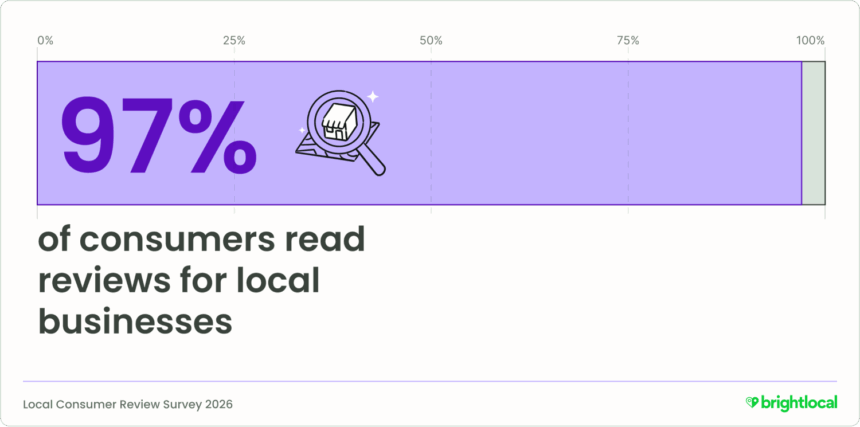
Reviews are a vital part of the business decision-making process, with 97% of consumers reading reviews online.
In 2026, 41% of consumers “always” read reviews when browsing for businesses, a huge jump from last year (29%).
Wider shifts may help explain why review-reading has become more important this year. The US economy grew more quickly than expected in 2025, after a slow start to the year following the USA’s introduction of significant tariffs for many countries. Businesses adjusted supply chains and, in some cases, passed higher costs on to customers.
At the same time as rising prices, many consumers have had to dip into savings to handle economic changes, and product quality has declined in many industries. For both big brands and local businesses relying on third-party suppliers, substandard goods can make consumers wary. With higher prices and lower quality, it makes sense for savvy consumers to do more research before choosing a business.
Google is Losing Traction, but AI and Video Reviews are Picking Up Speed
The Top Sites for Reviews in 2026
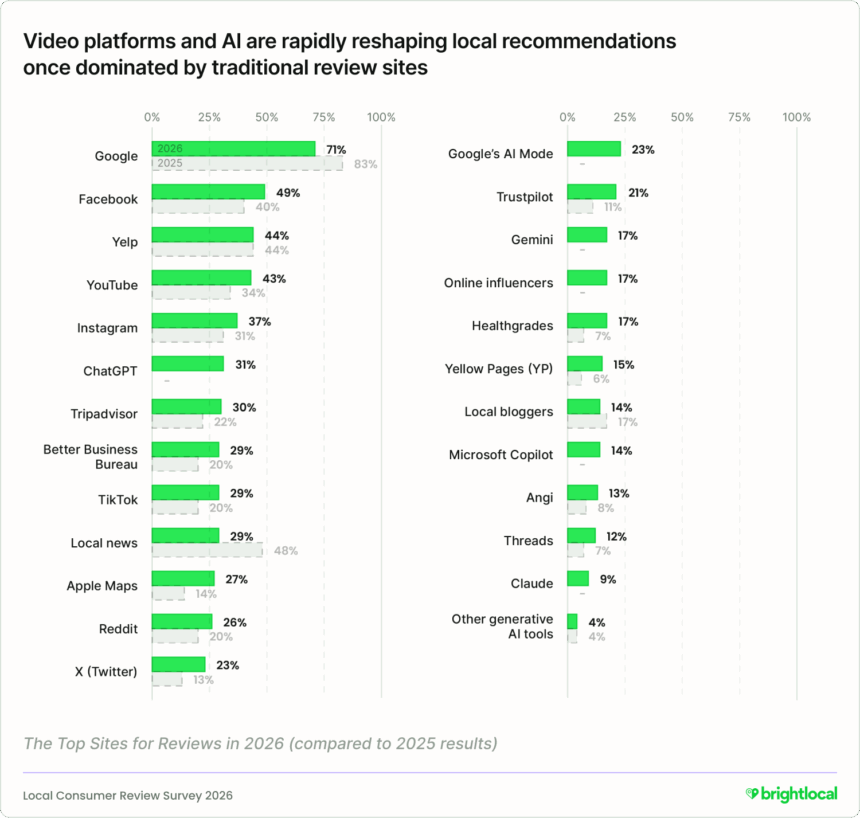
With consumers using an average of six review sites in 2026, relying only on the major review sites is no longer enough.
Google has always been the standout source for reviews, but this year its share has dipped from 83% in 2025 to 71%. Of course, Google is still far ahead of other platforms, but recent BrightLocal research found that just 35% of SMBs have a Google Business Profile, leaving many consumers unable to read or write Google reviews.
Video platforms are on the rise, with YouTube, Instagram, and TikTok all gaining traction. These non-traditional reviews by both influencers and everyday users provide quick, visual, and engaging insights into businesses. TikTok’s Local Explorer Program mirrors Google Local Guides, highlighting the growing importance of non-traditional reviews for consumers.
One key story this year is the growth of AI. You knew this was coming, didn’t you?
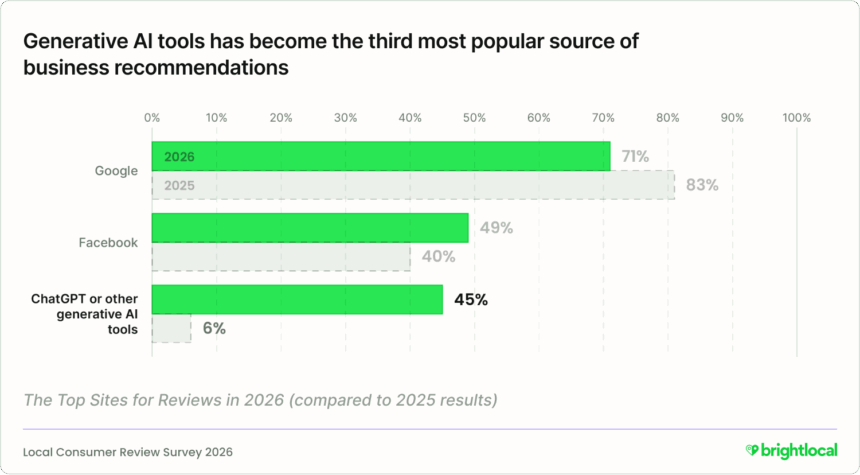
Use of ChatGPT and other generative AI tools for local recommendations has grown rapidly, rising from 6% last year to 45% and becoming the third most popular source of business recommendations.
However, it’s not just newer technologies that are experiencing growth; many traditional review sites are too.
Facebook, Tripadvisor, BBB, Apple Maps, Trustpilot, Healthgrades, Yellow Pages, and Angi all saw increased usage over the last 12 months. Apple Maps nearly doubled in usage from 14% in 2025 to 27%. It seems clear that for 2026, traditional review sites have nothing to worry about.
One notable decline is local news sites, which fell sharply from 48% to 29%. This shift may reflect two linked trends: the accelerating closure of local newspapers, and the impact of AI overviews on falling search traffic. These sites still help reach local audiences, but declining use means businesses and consumers may risk losing them entirely if they don’t use them.
What This Means for Businesses
With the way consumers are using reviews changing, in 2026 businesses should:
- Strengthen your presence beyond Google: Consumers use a wide mix of platforms when seeking recommendations. While Google is (and will remain) the frontrunner, businesses should be collecting reviews everywhere your customers are.
- Focus on information accuracy: With more people turning to AI tools for recommendations, keep your website up-to-date, monitor business listings for inaccuracies and build local citations on relevant niche and local sites, and check any sources that AI tools reference. If something is wrong, ask for a correction.
- Prioritize video as a marketing channel: Consumers are turning to video for recommendations more and more. Support customers and creators to review your business using video. Make your business visually appealing, thank those posting videos, and ask to use their clips in your marketing.
Consumers Expect Higher Star Ratings and Recent Reviews
When deciding which business to use, consumers look far beyond the stars. The number of reviews a business has, the recency of its reviews, and the speed of the business owner’s response all affect trust. Understanding what matters most can help businesses focus their efforts where they count.
- The most important review factor is consistent sentiment across multiple reviews
- In 2026, consumers expect a higher star rating and more recent reviews than in previous years
- 47% of consumers won’t use a business that has fewer than 20 reviews
- 74% only care about reviews written in the last three months
- 31% of consumers will only use a business that has 4.5+ stars
Shoppers Care About Consistency, Positivity, and Recency
| Rank | Factor | Response |
|---|---|---|
| 1 | The review is backed up by other reviews with similar sentiment | 56% |
| 2 | The written review describes a positive experience | 46% |
| 3 | The review has been posted within the last month | 44% |
| 4 | The review has a high star rating | 42% |
| 5 | The business owner has responded to the review | 37% |
| 6= | The written review has spelling and grammar of high quality | 36% |
| 6= | There is an appealing photograph or video of the product or service accompanying the review | 36% |
| 7 | The reviewer is named, rather than anonymous | 35% |
| 8 | Other users have ‘liked’ or reacted to the review | 30% |
| 9 | The reviewer has posted reviews for various different businesses | 27% |
| 10 | The review is long and detailed | 26% |
As a business owner, it may feel overwhelming to guess what customers want to see in your reviews.
The most important factor is whether a review is backed up by others with a similar sentiment. Most consumers won’t be satisfied by a single glowing review. Instead, they look for consistent themes across reviews, whether that’s repeated praise for customer service or warning signs like regular complaints about cleanliness.
Beyond this, the most important review factors are that the review described is positive (46%), that the review was posted in the last month (44%), it has a high star rating (42%), and that the owner has responded to the review (37%). This reinforces that asking for reviews is an ongoing process. Consumers expect recent feedback and clear signs that businesses are listening.
Consumers are least likely to care about a long, detailed review. When asking for reviews, remind customers it doesn’t need to take long—short and happy works perfectly!
How many reviews does a business need? Perhaps it’s more than you think…
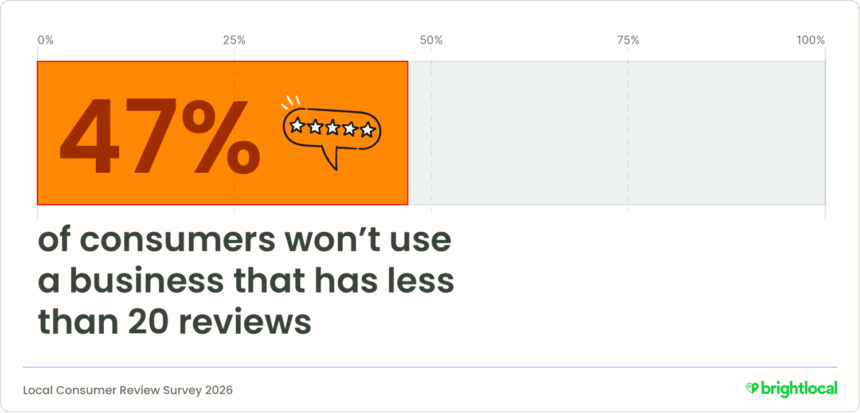
47% of consumers won’t use a business with fewer than 20 reviews, and only 9% are willing to use one with five or fewer.
The number of reviews signals credibility to potential customers. Most customers won’t base their decision on a single review: they want reassurance that a business consistently delivers a good customer experience. Even if they don’t read every review, a higher review count creates social proof and reduces perceived risk.
For new businesses, collecting reviews from early customers is crucial. Nobody wants to be the first to take a chance, so showing that people have already trusted your business helps reassure potential customers.
Does review recency really matter in consumer decision-making? Emphatically, yes.
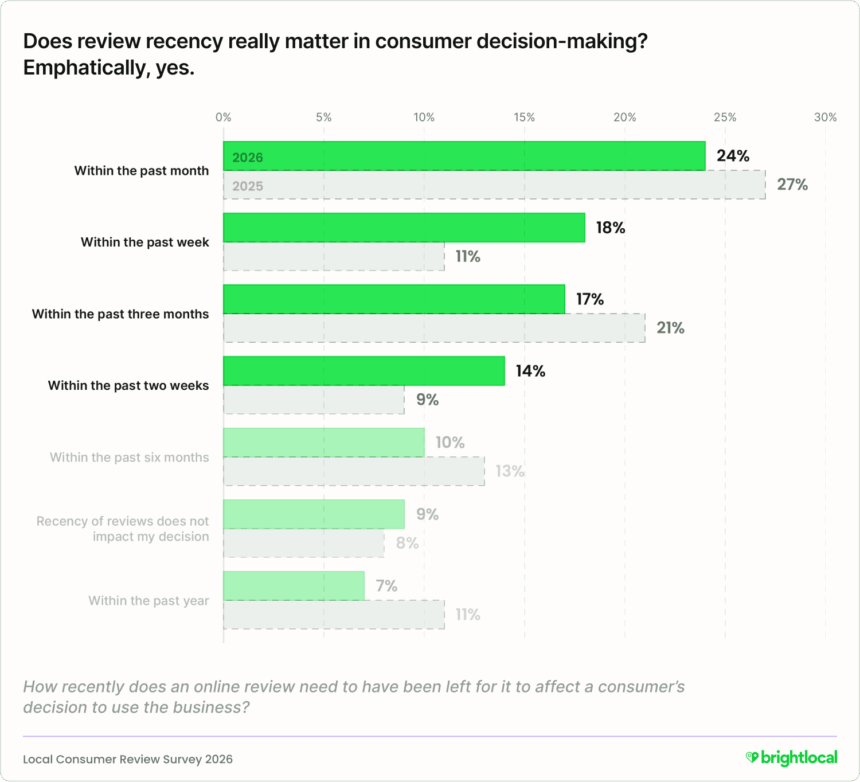
Consumers expect reviews to be new, and in 2026, recency has become even more important to decision-making.
18% of consumers are only swayed by reviews written within the last week. 32% look for reviews written in the last two weeks, a huge jump from last year (20%).
74% seek reviews written in the last three months. We get it: older reviews may no longer be relevant, especially if the business has changed staff, updated services, or improved customer service.
For business owners, this means review collection should be continuous rather than occasional. Encouraging customers to leave reviews over time means your review profiles stay up-to-date and truly reflective of your business today.
Star Ratings Keep Rising with Consumers Demanding Four or More
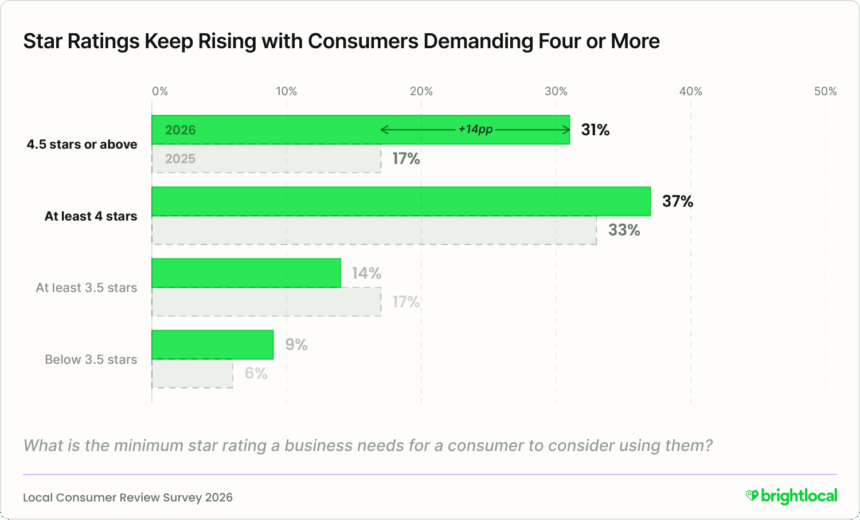
92% of consumers care about star ratings when choosing a business, with the stars they require continuing to rise.
Luckily for businesses, just 10% of consumers say they will only use businesses with a five-star rating, so there’s no need to sweat if you drop a few decimal places.
In 2026, 31% of consumers will only use a business with 4.5 stars or more. This is up from 17% last year, meaning a drastic increase in consumer expectations in just one year. Seven in ten (68%) will only use a business with four or more stars, up from 55% in 2025.
With expectations rising sharply in just one year, a business that was acceptable in 2025 may now be seen as substandard. Businesses that don’t spend this year improving star ratings across review sites could see fewer customers through the door, while those sitting in the 4.5-5 star sweet spot could see a boost in footfall.
What This Means for Businesses
Online reviews are more than just star ratings, with consumers looking at multiple features to guide decisions. Businesses should:
- Build a strong review profile: Take stock of your reviews across all platforms, spot any gaps, and fill these in pronto. Make sure you have plenty of reviews, as people will read several before making a decision.
- Keep reviews recent: Regularly request reviews from customers so your review profiles reflect the current state of your business. Make it easy by automating requests via email or SMS, adding links to receipts, or following up after a visit.
- Boost star ratings: Audit your star ratings across platforms, and focus on getting more reviews where you’re lagging. Even a small increase can make a big difference.
Reviews Drive Purchases, but Many Consumers Still Need More Evidence
Reviews affect the decisions consumers make and the steps they take toward a purchase. Some feel confident spending large amounts directly after reading reviews, while others continue researching using other channels before being ready to buy.
- 85% of people are more likely to use a business after reading positive reviews, while negative reviews deter 77% of consumers
- After reading positive reviews, 54% of consumers then check the business’s website
- Consumers are more likely to do more research (66%) than make a purchase or booking (34%) after reading a positive review
- 93% of consumers have made a purchase after reading reviews, with 27% spending over $1,000
- 70% of consumers have made a purchase they later regretted after reading reviews, with 14% regretting spending over $1,000
The Opinions of Strangers Make or Break Decisions to Use Businesses
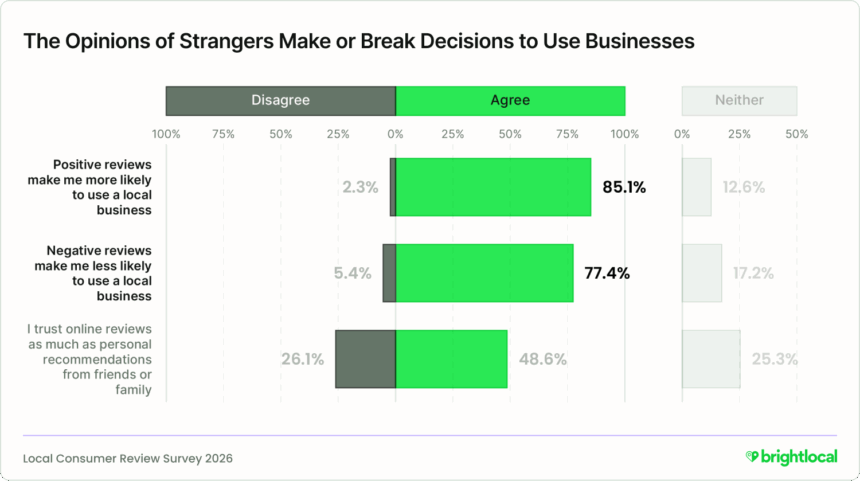
For over 15 years, we’ve been tracking whether consumers trust reviews as much as personal recommendations. While trust in reviews has fluctuated over time, it still sits at a significant 49% today. That means nearly half of consumers place as much trust in the views of strangers online as they do in the people they know, underlining just how influential reviews remain in the decision-making process.
Reviews continue to play a powerful role in shaping trust and influencing decisions. A huge 85% of consumers say positive reviews make them more likely to use a business, while 77% say negative reviews make them less likely to choose one. This shows just how strongly reviews can sway opinion in either direction, reinforcing good experiences and amplifying poor ones.
Reviews Make 1/3 Ready to Buy, But Most Need More Research
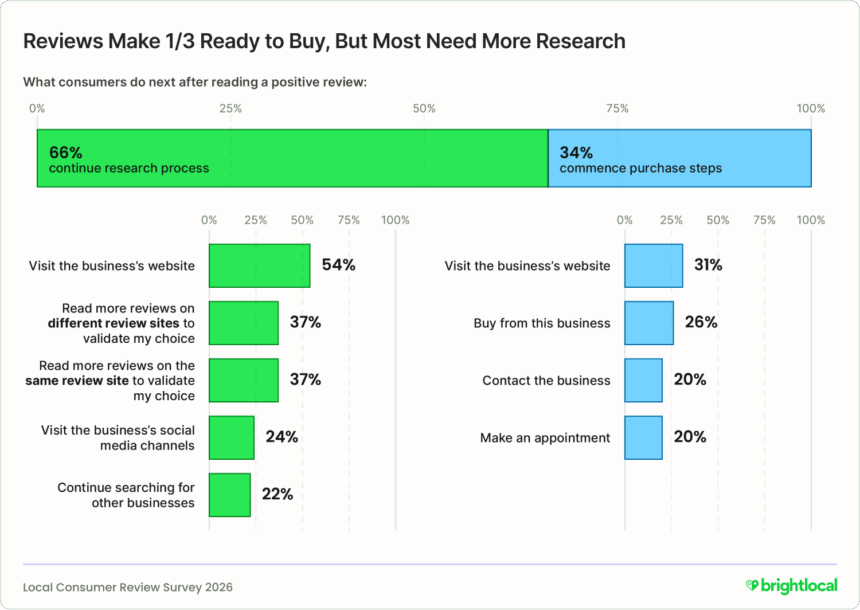
While reviews can cause immediate purchases, the path to buying is often longer. We asked consumers which actions they were likely to take after reading positive reviews. Respondents could select multiple actions, so their path may vary depending on business type or what they’re buying.
Grouping these actions into ‘Research’ versus ‘Purchase’ steps shows that 66% of consumers do further research after reading a positive review, while 34% are ready to buy or make a booking. An online review is a great push in the right direction, but for many consumers, they need to be able to find out more about a business and its offering. Most consumers seek additional information: 37% go on to read more reviews, and 24% visit the business’s social media channels.
Consumers are most likely (54%) to visit a business’s website after reading positive reviews, up significantly from 32% when we last asked this in 2019. With just 40% of local businesses having a dedicated website, many consumers could be dropping off at this point in the funnel. Websites should be up to date, easy to navigate, aligned with customer reviews, and simple for customers to take the next step.
Reading positive reviews is enough for a significant proportion of consumers to feel ready to buy. Some visit the business location (31%), contact the business (20%), or make an appointment (20%).
Reviews Matter for Purchases Big and Small
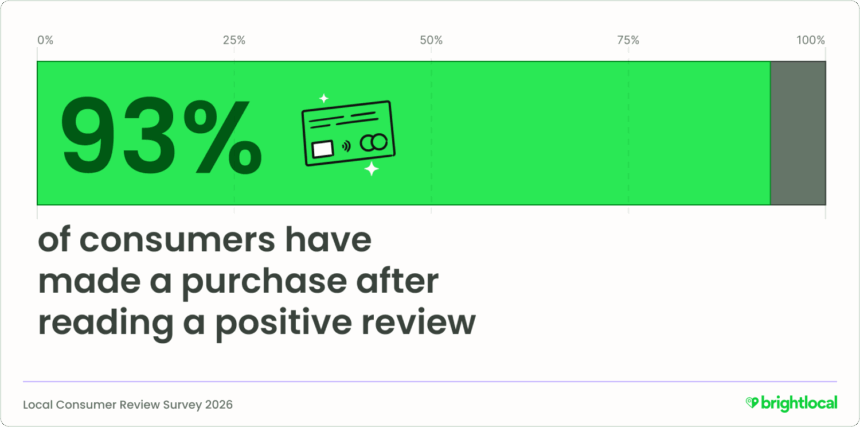
For many consumers, reading reviews is a key part of the purchase journey. 93% of consumers have made a purchase after reading reviews. In many cases, purchases are relatively small, with half spending less than $500.
Reviews are not just for restaurants or tourist spots; consumers regularly rely on them for high-value purchases. In fact, 27% of consumers have spent more than $1,000 after reading reviews, with 13% spending over $5,000.
Reviews Reduce Risk, But Don’t Eliminate It
Despite reviews being highly trusted and used by consumers, reading reviews is not always enough to prevent buyers’ remorse. 70% of consumers have made a purchase they regretted after reading reviews.
For 18% this was less than $50, but for many, the money wasted was significantly higher. 14% regret spending more than $1,000 after reading reviews, with 2% regretting spending more than $10,000.
Reviews can help consumers make more informed decisions, but they are not infallible. Fake or misleading feedback has the potential to cause significant financial consequences, even for careful shoppers. This reinforces why review authenticity matters as much as quantity.
What This Means for Businesses
Reviews do more than build trust; they directly impact consumer action. Businesses should:
- Make customer research easy: Most consumers will do more research after reading a positive review, so make sure your website, social profiles, and business listings are accurate and easy to navigate. Clear paths to contact, book, or buy make it easy for interest to turn into action.
- Be visible across multiple review channels: Consumers aren’t tied to one review platform, and often seek reassurance on other channels. Check your review presence is consistent across different sites, and if not, prioritize lagging channels.
- Support big-ticket purchases: Reviews also influence high value purchases. If your business serves fewer, higher-spending customers, it’s especially important to encourage them to leave reviews.
How a Business Responds to Reviews is as Important as the Review Itself
Consumers pay close attention to responses from business owners and expect replies almost immediately. Quick and personalized responses signal that a business cares about its customers, while ignoring reviews or responding with generic templates erodes trust.
- Businesses that respond to every review are more likely to be used by 80% of consumers
- 42% of consumers are unlikely to use a business that ignores its reviews entirely
- 89% of consumers expect business owners to respond to reviews
- 19% of consumers expect a same-day response to their review, while 81% expect a response within a week
- Templated or generic responses make 50% of consumers unlikely to choose a business
Each Review Needs a Response, but Generic Replies Do More Harm Than Good
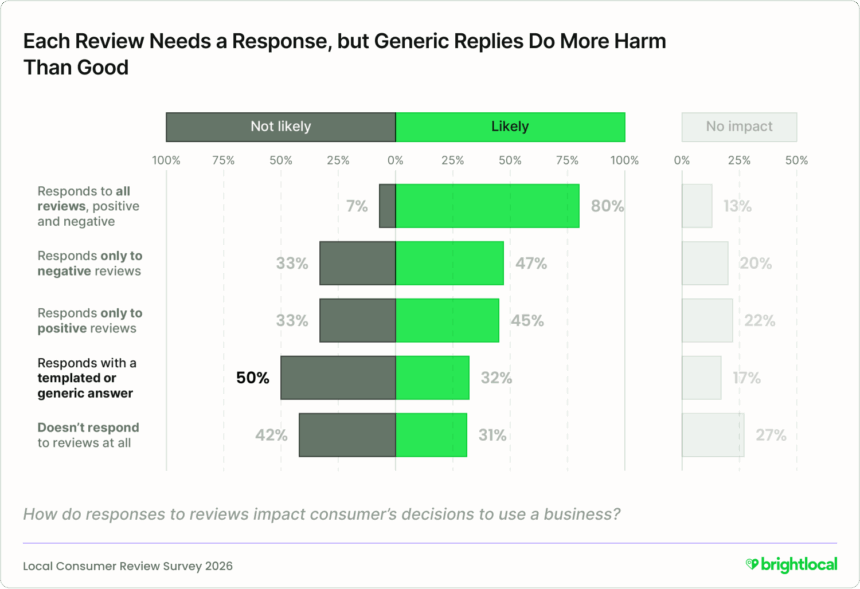
80% of consumers say they’re likely to use a business that responds to all of its reviews. 42% say they’re unlikely to use a business that never replies.
When looking at reviews split by sentiment, far fewer consumers are likely to use a business that responds only to positive (45%) or negative (47%) reviews. If you want to impress potential customers, it’s important for businesses to respond to each and every review, whether it appears to ‘need’ a response or not.
Yet for many consumers, a token response simply isn’t enough. Generic or templated replies put off 50% of consumers, who may see them as a sign of subpar customer care.
Taking time to personalize responses makes a real difference, but you don’t need to start from scratch every time. Review response templates and review management tools with in-built AI suggestions can act as a strong starting point, helping businesses tailor replies into responses that feel genuine and unique.
There’s No Time to Wait When Responding to Reviews
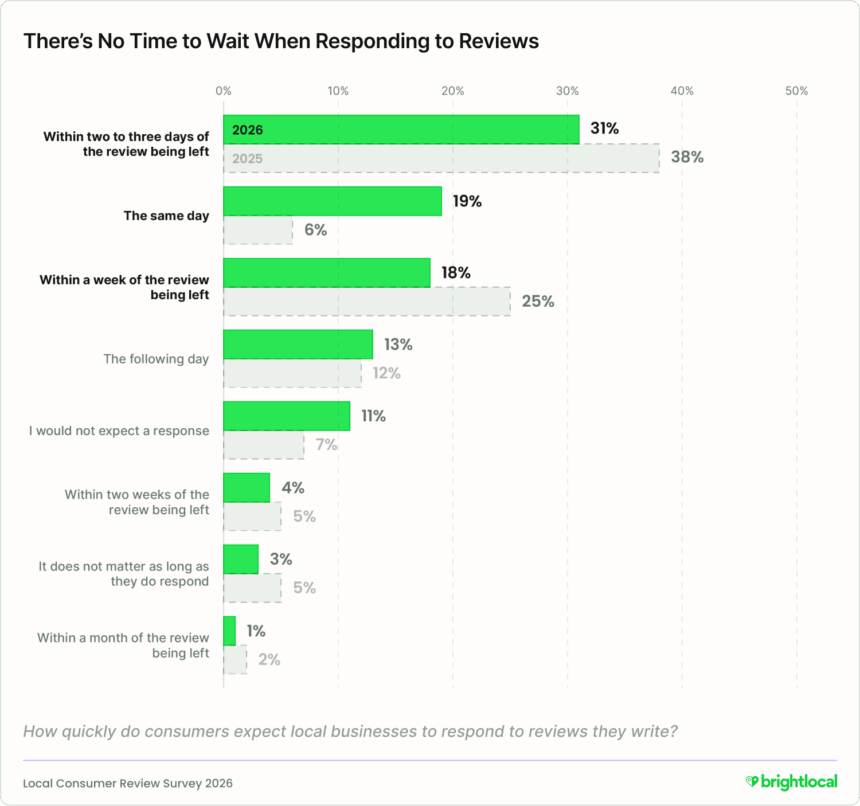
With 89% of consumers expecting a response to their reviews, businesses can’t afford to ignore them. But how rapid should responses be?
19% of consumers expect a response to their review on the same day they post it, up from 6% last year. 32% of consumers want a response by the following day (up from 18% in 2025), and 81% expect to hear back within a week.
The rising expectations on speed show how important responsiveness has become. As customers interact with brands in real time on messaging apps or social media, slow replies can feel outdated and unwelcome. Quick responses show customers their feedback hasn’t disappeared into the void.
What This Means for Businesses
Review responses shape customer trust and impact purchasing decisions for future customers. To create an end-to-end review strategy in 2026, businesses should:
- Respond to every review: Consumers notice when businesses ignore feedback so take the time to consistently respond with gratitude.
- Make it personal: Generic or templated responses have a negative impact, so don’t use the same reply every time. Rotate between multiple tailored templates, or use AI-assisted responses to speed up the process, but keep these genuine and tailored to the feedback.
- Respond quickly: Reviewers expect almost instant responses to reviews, so there’s no time to dilly-dally. Closely monitor reviews across every site using reputation management tools so you can respond promptly.
AI is Quickly Becoming a Go-to for Business Recommendations
Reviews have long been a cornerstone of trust for local consumers, helping them make confident decisions. Now, with AI increasingly influencing recommendations, trust is beginning to extend beyond review platforms and into AI-powered tools.
Stay tuned as we dive deeper into how AI is influencing local business recommendations.
Subscribe to the BrightLocal newsletter to get the insights first.
- 40% of consumers trust AI platforms to provide business recommendations
- 42% trust AI platforms as much as traditional reviews for local recommendations
- 82% of consumers read AI-generated review summaries, with 23% willing to rely solely on these to make a decision
More Consumers Trust AI Than Fear It for Business Recommendations
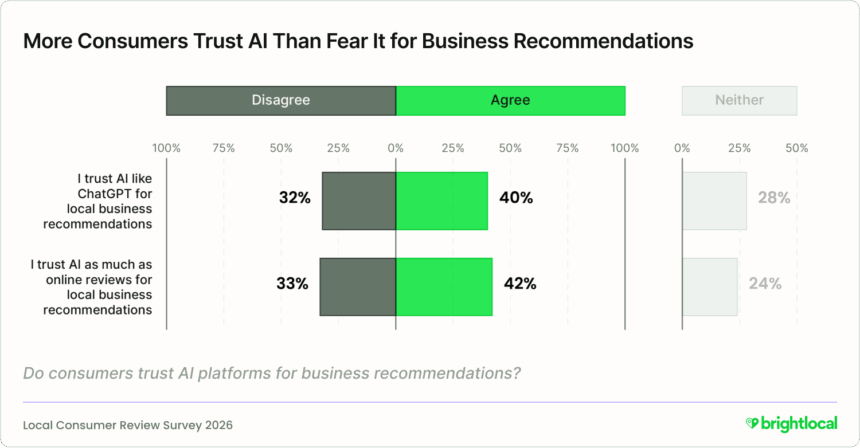
With the advent of any new technology, we’d expect to see slow pickup and levels of distrust as people get used to it. Yet, the levels of consumer trust in AI for local searches are surprisingly high, with more users trusting them (40%) than not (32%).
AI recommendations are trusted as much as traditional reviews by 42% of consumers. There’s still a long way to go for AI recommendations to be fully trusted, but this does suggest that those already using AI find recommendations generally reliable.
AI tools vary widely in how they source information. As AI evolves, it’s plausible that recommendations will become more closely aligned with review sources, particularly where platforms own both the reviews and the AI experience, as we’re already seeing with Google. In the long run, this could lead to greater trust in AI-powered recommendations.
AI Review Summaries Streamline Decisions, but Don’t Replace Full Reviews
How do consumers use information from AI review summaries when deciding to use a local business?
| Statement | Respondants |
|---|---|
| I would be happy to read only this information to guide my decision | 23% |
| I would read this information, as well as a variety of positive and negative written reviews to guide my decision | 39% |
| I would read this information, and use the overall review rating to guide my decision | 14% |
| I would read this information, and search or filter reviews for relevant information to guide my decision | 6% |
| I would not read the information summarized by AI to guide my decision | 18% |
Even for consumers not directly using AI tools like ChatGPT, AI is becoming increasingly difficult to avoid. Platforms like Google and Amazon use AI to create snippet summaries above individual reviews, helping consumers spot trends without needing to read every review. Only 18% of consumers skip these summaries, making them important to be aware of for businesses.
The majority of consumers (82%) read these review summaries to inform decisions. 23% are happy to read just this information before making a decision, while 59% use summaries as a starting point, then check star ratings, read full reviews, or filter for specific information.
While summaries streamline decision-making, they can obscure details like photos, videos, and review recency, which may make spotting fake reviews harder. On the upside, reviews shaping AI summaries may stay influential longer, as consumers may be less aware of when these were posted.
What This Means for Businesses
As AI becomes a bigger part of how consumers find and choose companies, business owners should:
- Keep growing and managing reviews: Don’t slow down on review management just because there are new shiny tools out there. Your review profiles remain a core trust signal that influence both customers and AI tools.
- Don’t underestimate AI: Consumer trust in recommendations by AI tools is growing surprisingly quickly, and will only continue to grow. Monitor how your business appears in AI-generated recommendations and summaries, and proactively manage your reputation to ensure AI works in your favor.
- Ensure your online presence is AI-ready: Understand the sources AI tools rely on, and make sure your information is easy to understand for customers and robots alike.
Consumers Demand Real Consequences from Fake Reviews
Fake reviews remain a major concern for consumers and businesses. Misleading feedback can influence decisions and even lead to wasted money. With new regulations in place, fake reviews finally face scrutiny, with consumers expecting action from review sites and significant punishments for wrongdoers.
- 97% of consumers think businesses should face punishment for fake reviews
- Consumers believe businesses caught using fake reviews should be banned from review platforms (57%) or removed from Google search results (46%)
- 16% think fake reviews should result in criminal charges or jail time for the business owner
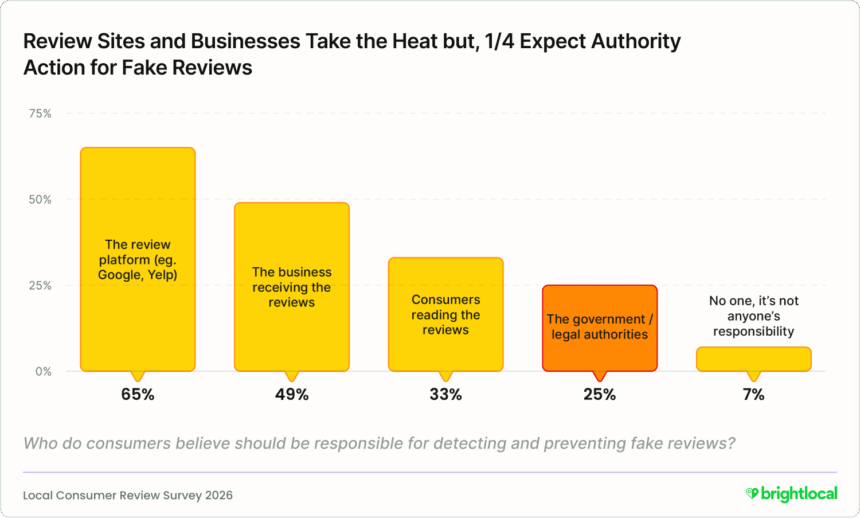
- 63% of consumers think review platforms should be responsible for detecting and preventing fake reviews
- 25% think the government and legal authorities should be detecting and preventing fake reviews
Review Sites and Businesses Take the Heat, but 1/4 Expect Authority Action for Fake Reviews
For years, fake reviews have been testing consumers and businesses. In 2024, the FTC introduced the long-awaited law regulating fake and misleading reviews. This law makes buying and writing fake reviews illegal, with any business or individual caught facing significant fines.
But should businesses be responsible for catching fake reviews? Yes, according to 49% of consumers. For now (and let’s be realistic, for the foreseeable future), it falls to businesses to spot and report fake reviews themselves.
Consumers are most likely (63%) to believe the onus for stopping fake reviews should sit with review platforms. Google blocked 240 million fake or policy-breaking reviews in 2024. Even at this scale, fake reviews are a lingering problem made worse by scammers attempting to game the system or even extort businesses.
A quarter (25%) believe fake reviews should be the responsibility of the government or legal authorities. The new law provides clear rules on fake and misleading review practices, but it seems pretty unlikely that official sources will spend much time spotting fake reviews.
Consumers Call for Fake Review Punishments from Bans to Jail Time
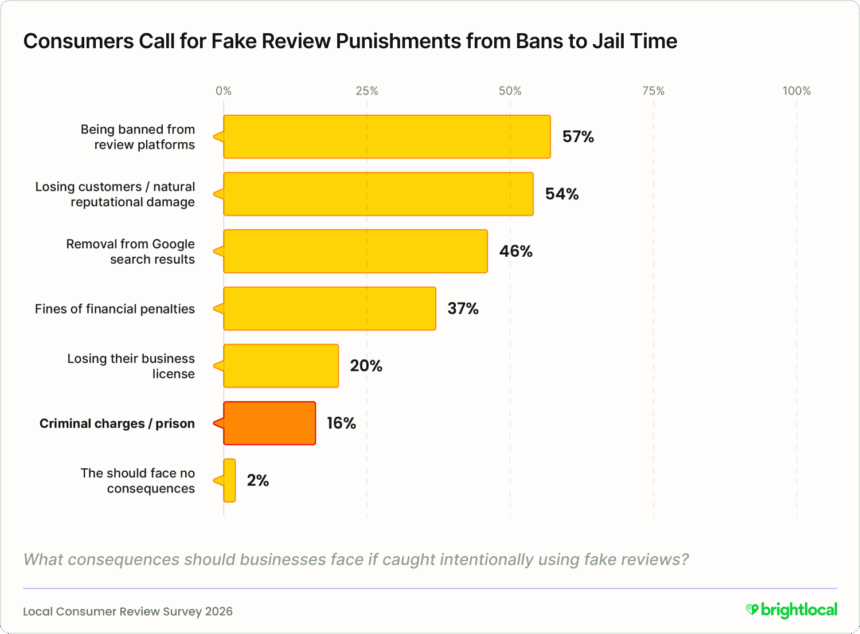
With consumers expecting action on fake reviews, what do they see as an appropriate consequence? 54% believe businesses should naturally lose customers as their reputation is damaged, while others may expect more severe measures.
57% of consumers believe that a business caught using fake reviews should be banned from review platforms. And 46% want rule-breaking businesses removed from Google search results.
Some consumers favor even harsher consequences. One in three (37%) think businesses should face fines or lose their business license (20%), while 16% think fakers should face criminal charges or even prison!
Just 3% think there should be no consequences for fake reviews, meaning 97% of consumers expect businesses to be punished in one way or another!
What This Means for Businesses
Fake reviews are still a major concern for businesses, and expectations for accountability are high. To guard your reputation, businesses should:
- Monitor and report fake reviews: Keep a close eye on every review profile, and report any suspicious reviews before they influence readers. If you suspect competitors could be buying or posting fake positive reviews, report these too.
- Maintain your integrity: Even if it feels like everyone else is doing it, never post fake reviews for your business. Consumers are increasingly savvy, and being caught can damage trust, reduce visibility on review platforms, or even land you with a hefty fine.
- Know the rules: With laws finally in place to govern reviews in the US, as well as review site guidelines to follow, make sure you understand the rules so you stay compliant.
Positive Experiences Drive Reviews, but Businesses Still Need to Ask
Most consumers write reviews at least occasionally, whether for an exceptional experience, a poor one, or something in between. While many reviews are written voluntarily, asking customers to leave a review can significantly boost your review count.
- 94% of consumers are open to writing reviews, though just 69% of consumers wrote a review in the last 12 months
- Consumers are more likely to write about positive experiences (60%) than negative ones (29%)
- 78% of consumers were asked to write a review in the last 12 months, with 65% writing one after being asked
- The average consumer writes between 4 and 6 reviews per year
- The most popular sites for writing reviews are Google, Facebook, and Yelp
Customers Share Wins More Than Woes
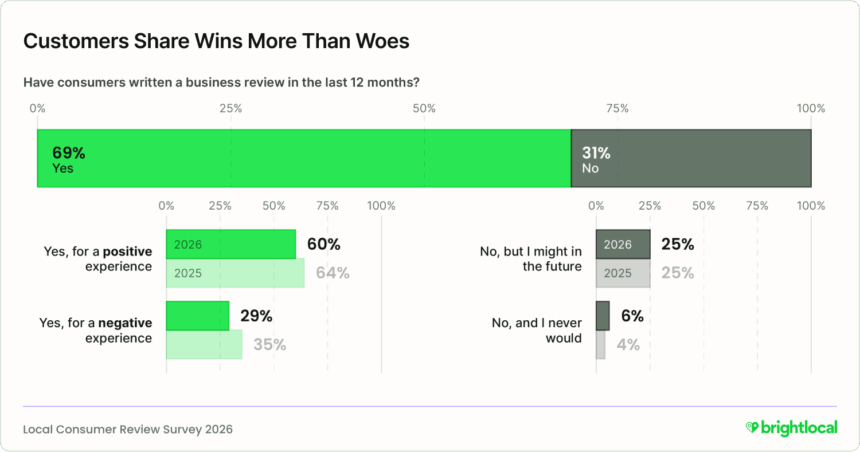
In the last 12 months, 69% of consumers wrote a business review, with positive experiences (60%) far more likely to be shared than negative ones (29%). This year, fewer consumers wrote bad reviews: are businesses upping their game, or are unhappy customers keeping complaints to themselves?
Only 6% of consumers say they wouldn’t write a review, meaning the vast majority (94%) are open to leaving a review if you catch them at the right moment!
Every Voice Counts, From Small Fries to Super Reviewers
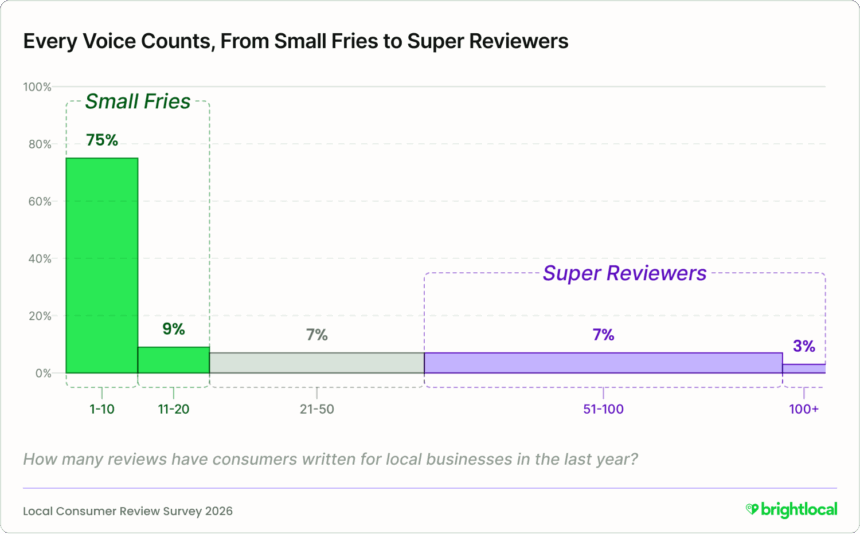
A typical consumer writes between 4 and 6 reviews each year. 7% write just one review, with 47% writing six or fewer.
At the top end, 20% of consumers wrote more than 10 reviews in 2025. Just 7% wrote more than 50, meaning consumers are as likely to write 50+ reviews as they are to write just one!
This split between “Small Fries” and “Super Reviewers” highlights the power of an engaged customer base. Programs like Google Local Guides, Yelp’s Elite Squad, and now TikTok Local Explorer reward and recognize active reviewers. But remember, every review shapes perception, so make sure even casual reviewers feel valued.
Customers Write Most Reviews on Google and Facebook, but Keep an Eye on Apple
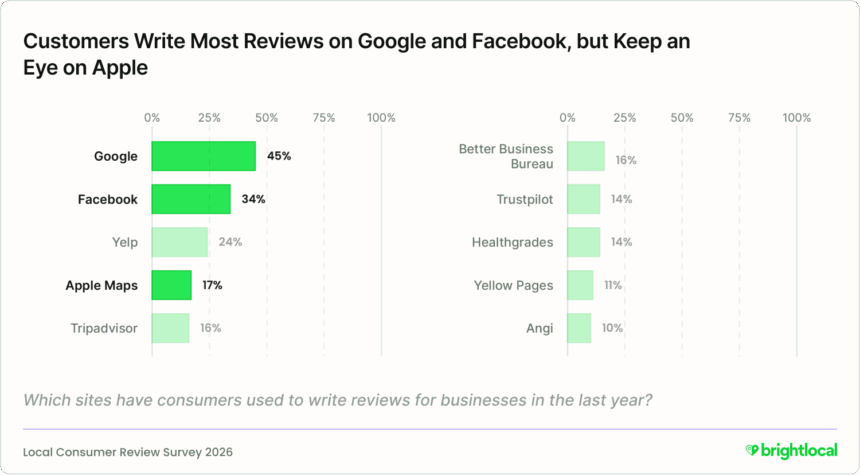
Google remains the most popular site for writing reviews, with 45% of consumers leaving a Google review in the past year. The platforms consumers are most likely to write reviews on largely mirror the sites for reading reviews:
- Google (45%)
- Facebook (34%)
- Yelp (24%)
- Apple Maps (17%)
- Tripadvisor (16%)
- Better Business Bureau (16%)
The exception here is Apple Maps, which was the sixth-most-visited site for reading reviews but fourth for writing reviews. Unlike other sites, Apple Maps only lets users rate, generating a percentage score. This simple system makes leaving feedback easy, which may explain its popularity.
Review Requests Get Results if Businesses Keep Asking
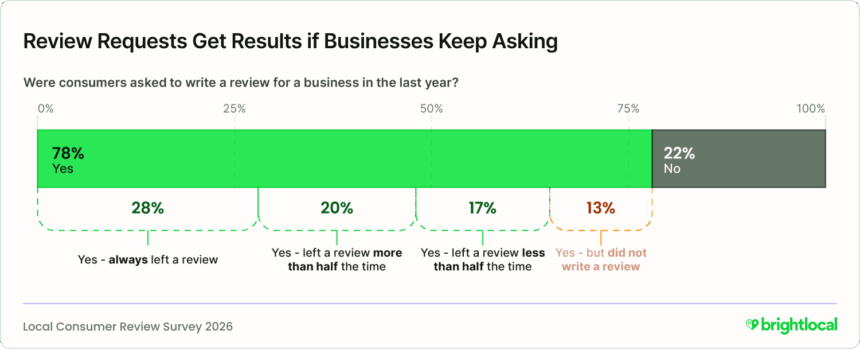
As we’ve always said, the best way to get more reviews is just to ask! Over the past 12 months, 78% of consumers were asked to leave feedback for a business, and the response has been strong.
28% of people say they will “always” write a review if asked, up significantly from 16% in 2025, showing a growing willingness to share experiences if prompted. In fact, 83% of people asked to leave a review went on to leave one this year.
While some customers are happy to leave feedback every time, others may need a gentle nudge at the right time with consistent and timely review requests.
Discounts for Reviews are Declining, but Some Businesses Risk Legal Action
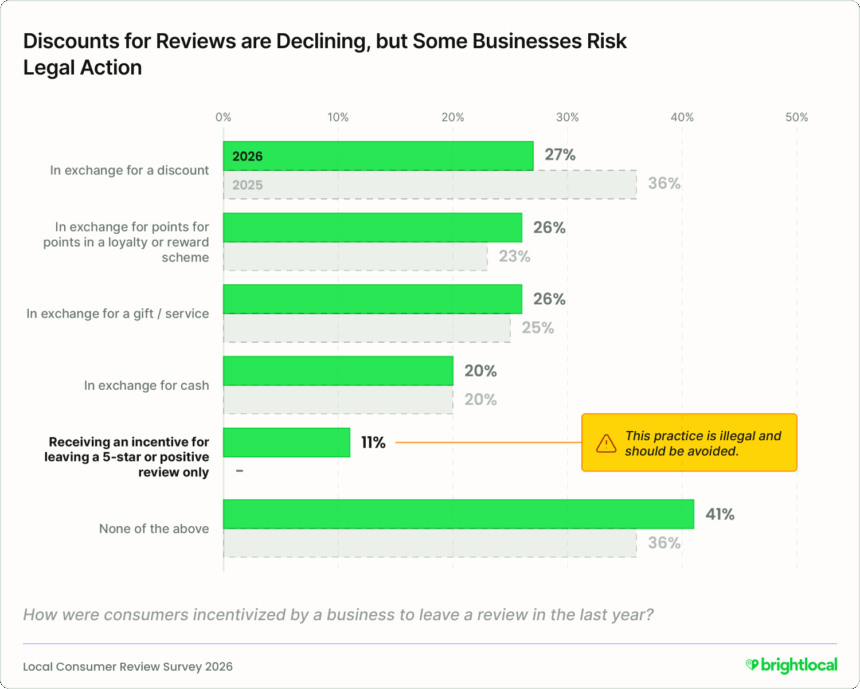
Businesses aren’t shying away from incentivizing reviews, with only a small decline in the proportion of consumers before being offered a reward (59%, down from 64%).
Requests for discounts have dropped sharply, from 45% in 2024 to 36% in 2025 and 27% this year. Offering incentives for reviews isn’t illegal, but it violates the guidelines of platforms like Google and Yelp, which could explain why fewer businesses are using them over time.
However, 11% of consumers were offered an incentive to write a positive review, which would land law-breaking businesses with a fine under the FTC’s Final Rule on Online Reviews if caught.
What This Means for Businesses
With most consumers willing to write reviews if asked, businesses should:
- Ask for more reviews: Treat review generation as an always-on marketing tactic. Ask as part of the purchase journey where appropriate, send requests with timely emails or SMS requests, and include links and QR codes on printed materials to make responding simple. Don’t be afraid to follow up.
- Focus on delivering review-worthy moments: Consumers are far more likely to write about positive experiences. Reward team members for standout service, and listen to customer feedback to make your business even better.
- Prioritize key review sites: Focus on the platforms your customers are most likely to use, from major sites to niche platforms that rank well for your local keywords. Build a strong presence and rotate where you request customers write reviews to grow profiles evenly.
The Review Outlook for 2026
Reviews remain an important tool for businesses, but in 2026, consumer behavior is shifting. People are seeking recommendations from a wider range of sources, including video and AI platforms. Google is seeing dips, while other review sites are growing.
Consumers expect higher star ratings and recent reviews to guide decisions. As well as influencing trust, reviews are driving action. For many, reviews lead straight to high-value purchases, while others follow up with more research before jumping into a decision.
Businesses’ requests for reviews continue to influence customers to write them; however, some businesses are breaking the law by asking for explicitly positive reviews.
Fake reviews continue to worry consumers, with many wanting more action and harsher punishments. With many consumers regretting purchases even after reading reviews, shoppers want to feel able to trust the legitimacy of reviews.
AI is picking up speed for local searches, with consumers using a variety of tools to find information about businesses. We’ll be digging more into the link between AI and local business recommendations soon, so make sure you’ve subscribed to our newsletter to read this first.
Thanks for reading this year’s Local Consumer Review Survey; we hope it has given you practical insights and actionable next steps for your business.
If you have any feedback, questions about the report or data, or want to share the findings you found most impactful, don’t hesitate to get in touch! You can email the research team, post in The Local Pack, or reach us on our socials via LinkedIn, Bluesky, and X.
Methodology
| Age group | % of consumer panel |
|---|---|
| 18-29 | 22% |
| 30-44 | 25% |
| 45-59 | 28% |
| 60+ | 25% |
The Local Consumer Review Survey 2026 was conducted using a representative panel of 1,002 US adult consumers via SurveyMonkey.
Publications and individuals are welcome to use our research findings, graphics, and data, citing BrightLocal as the author and the page URL: https://www.brightlocal.com/research/local-consumer-review-survey.